

 GIRIRAJ CIVIL DEVELOPERS LTD NSE
-
By @GirirajCivilDev
-
July 28, 2026
- 0 Comment
Tunnel Hood Technology and the Bullet Train: What Mountain Tunneling on MAHSR Teaches Civil Contractors
The Mumbai-Ahmedabad High-Speed Rail (MAHSR) project has reached a significant engineering milestone. According to the National High Speed Rail Corporation Limited (NHSRCL), tunnel hood technology has been designed and implemented for a railway tunnel in India for the first time. For civil contractors and engineers working on high-speed rail infrastructure, this development is worth close attention.
While this particular tunnel is being executed by other agencies, the underlying engineering challenge it addresses, managing air pressure at extreme speeds, is one that every contractor working on high-speed rail corridors will eventually encounter.
What's Actually Happening in These Mountains
The MAHSR corridor has been created to connect Mumbai (a city of about 37 million inhabitants) and Ahmedabad (the third largest city, second largest metro and the capital of Gujarat) a distance of just short of 508 km, and for the most part, it is a viaduct. However in the parts of the alignment in Maharashtra and Gujarat, where the train route crosses natural barriers of the topography that can not be avoided, a number of mountains had to be dug through.
Altogether there are eight tunnels and only two of them are on the Maharashtra-Gujarat border.
Seven of the tunnels are located entirely in Maharashtra and, among those, six are under the Western Ghats and in the Palghar district and only one is close to the state border.
Together these mountain tunnels make up just over 6km, a length that may not be great in the context of large tunnels but for each tunnel the ground they are set in will make a very long story if you are thinking of not completing the project, i.e., not getting there!
Since the first breakthrough in Valsad tunnel in Gujarat has been reported, the Palghar twin tunnels on the Maharashtra part have followed closely one after another, with the second one completed just a month after the first. Such rhythm shows how well-timed are these operations by the teams, that is how much are they in control.
The Piston Effect Nobody Talks About Until It's a Problem
Here’s the part that doesn’t get explained often enough. When a train enters a tunnel at 320 kmph, it’s basically shoving a huge column of air ahead of it, the same way a piston pushes air inside a cylinder. That air has nowhere to go except through the tunnel, and it compresses fast. That compression turns into a pressure wave that travels down the tunnel and, when it hits the far end, can come out as a loud boom. Anyone living near a portal will hear it and feel it.
At regular train speeds this barely matters. At bullet train speeds it’s a real engineering problem, and it’s one Japan dealt with decades ago on the Shinkansen network. India is now facing the exact same physics for the first time, which is honestly a good problem to have this early in the project rather than after the trains start running.
So What Exactly Is a Tunnel Hood
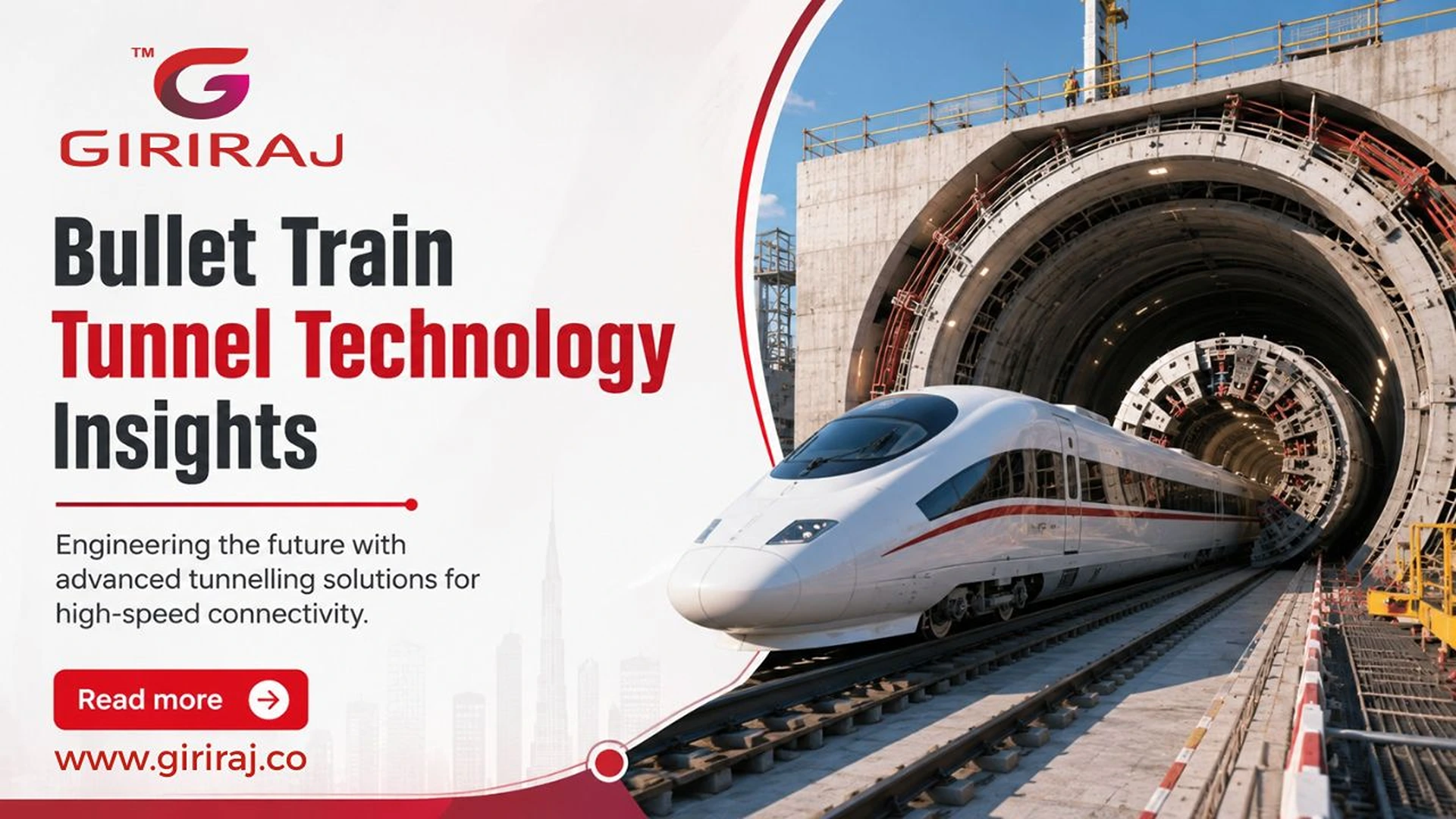
A tunnel hood is basically an extension built onto the tunnel portal, and it’s not solid the way the rest of the tunnel is. It has openings built into its walls that let air bleed out gradually instead of slamming into a dead end. Think of it as a buffer zone between the open air outside and the sealed tunnel space inside. The air pressure builds up gradually as the train enters this hood section, instead of all at once the moment it hits the tunnel mouth.
NHSRCL is installing these at both ends of every mountain tunnel on the route. The result, on paper, is less noise at the portals, less structural fatigue on the tunnel lining over time, and a smoother ride for passengers. It’s a fairly simple idea once you see the drawing, but getting the dimensions and the vent geometry right for a specific train speed and tunnel length is not something you eyeball.
Why NATM Was the Right Call Here
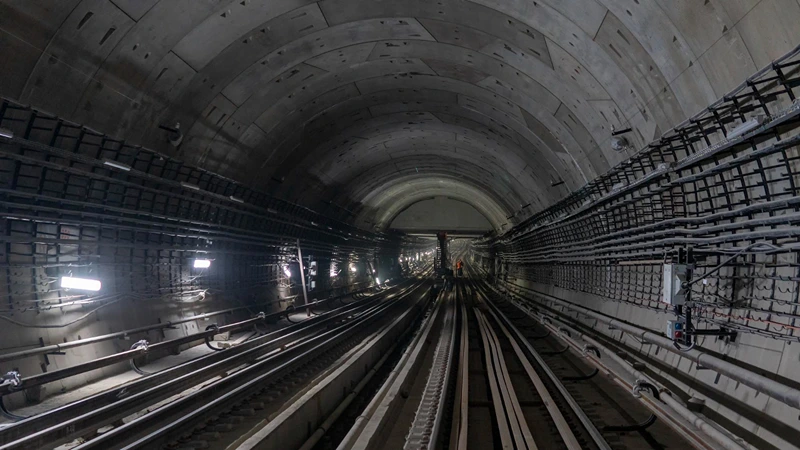
All eight mountain tunnels on this corridor are being built using the New Austrian Tunnelling Method, which is basically mark, drill, blast, clear the muck, and support, then repeat. It’s not the flashiest method compared to a tunnel boring machine, but for shorter tunnels through variable rock, it gives crews the flexibility to adjust support in real time based on what the rock is actually doing, not what a borehole survey predicted six months earlier.
The Valsad tunnel took about 10 months start to finish. The Palghar tunnel came in through an 18-month drill and blast cycle working from both ends at once. Numbers like that only happen when ground conditions are read correctly on site and support decisions get made fast, not after a delay while someone reruns a model.
What This Means If You're Running a Site
None of this is really about tunnel hoods specifically. For any railroad engineer or contractor working on high-speed corridors, it’s a habit worth building into every project: design the transition zones with as much care as the main structure. Contractors tend to pour everything into the tunnel or the bridge deck itself and treat the entry and exit points as an afterthought. MAHSR is a reminder that the boundary between two environments, open air and confined tunnel, high speed and slower approach, is often where the real engineering risk sits.
It also says something about sequencing and site discipline. A tunnel that breaks through in 10 to 18 months isn’t luck. It’s a crew that knows how to read rock, adjust support without waiting for permission from three levels up, and keep moving even when conditions change mid-project.
Where Giriraj Sees This Going
We expect tunnel hood style thinking to show up well beyond this one corridor. Any future high-speed rail line in India is going to hit the same air pressure physics the moment it enters a mountain tunnel, so this isn’t a one-off solution. It’s a new baseline.
At Giriraj, we work as a civil works contractor for Indian Railways, with experience spanning railway station construction, road over bridge (ROB) and foot over bridge (FOB) crossings, and the earthworks that go into every corridor. As a railway station construction contractor operating across some of India’s most demanding rail projects, we’re proud to be counted among the top construction companies in Mumbai taking on this scale of infrastructure work. One thing stays consistent across every project: the sites that plan for what happens at the edges, not just the middle, are the ones that finish on time and hold up for decades. That’s the same principle at play here, just applied to a train moving faster than anything India has run before.