

 GIRIRAJ CIVIL DEVELOPERS LTD NSE

-
By @GirirajCivilDev
-
September 29, 2026
- 0 Comment
Railway Yard Development: Planning Track Interfaces, Maintenance Access, and Safe Movement
The first real test of a railway yard is rarely a finished drawing. It is the moment a freight train arrives while a maintainer needs the turnout and a delivery vehicle is waiting near the crossing.
If the layout has been planned properly, each movement has a clear route and each person knows where to stand. If it has not, a small delay can turn into a blocked route, an unsafe crossing or a last-minute instruction over the radio.
Trains, shunting staff, maintainers, contractors, road users, signals, drainage, utilities and overhead equipment all meet at defined points. Those points are track interfaces, and they need to be planned as one operating system.
A yard can have good track geometry and still be difficult to operate. The staff route may cross an active siding. A drainage chamber may sit beside a turnout. Delivery vehicles may block the shunter’s sightline. These problems usually become expensive when they are found after construction has started.
Define the Interfaces and Governing Standards
Start with an interface register.
Include the main line, reception and departure lines, sidings, loading roads, depot roads, level crossings, drainage, signalling, overhead equipment, utilities, public roads and contractor access. For each item, record who owns it, who maintains it, which operating rule applies, which approval is needed, who inspects it and who should be contacted during an emergency.
Set the governing standards at the beginning. The infrastructure manager, railway board, regulator, host railroad or local rule book may control clearances, track centres, turnout geometry, electrification separation, possession terminology and signalling arrangements.
Use current controlled standards and a proper site survey. Generic dimensions taken from another railway system should not be copied into a project without local engineering review and acceptance. For example, a loading road that looks clear on a drawing may sit inside the maintenance or signal-equipment envelope once the actual turnout and access route are marked. Early engagement with the infrastructure manager is one of the simplest ways to avoid redesign later.
Bottom line: Every interface needs an owner, a rule, an approval route and a maintenance responsibility.
Plan Movements Before Fixing the Geometry
Draw the operating sequence before finalising the track plan.
Show arrival, reception, release, run-round, departure, loading, stabling, inspection and maintenance movements separately. For each movement, identify who gives authority, who sets and confirms the route, where the movement must stop and what happens if a radio, signal, point, detection system or vehicle fails.
Uncontrolled shunting can lead to runaways, collisions, derailments, serious injuries and fatalities.
The design review should test conflicting routes, sighting at points and signals, gradients and runaway risk, stabling and securing arrangements, communication failure, vehicles fouling adjacent lines, and staff or contractors entering the movement area.
Take a simple arrival movement as a test. What happens if the locomotive stops short of the loading road, a point fails to detect, or a contractor vehicle is still inside the route? If the answer depends on someone noticing the problem at the last moment, the layout and operating plan need more work.
Operating guidance in many railway systems assigns a responsible station or yard authority to coordinate shunting. The project should turn that principle into a local movement plan, competence requirement and clear limit of authority.
Bottom line: The track layout should follow the operating plan, not the other way around.
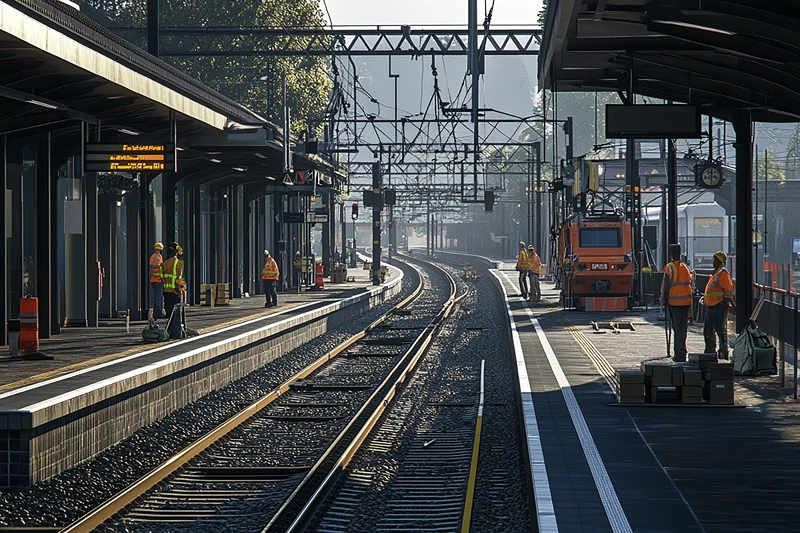
Coordinate Turnouts, Signalling and Crossings
Treat every turnout as a high-consequence interface.
Confirm its location, geometry, lead length, clearances, switch operation, maintenance space, walkway continuity and relationship to loading equipment, crossings, bridges and adjacent routes. Use the host railway’s standard plans and obtain engineering acceptance for unusual arrangements.
Points, derails, signals and route controls should be reviewed together. Where signalling is provided, define route setting, train detection, route holding, overlap or equivalent protection, and release logic. Interlocking should prevent conflicting movements and require relevant points and crossings to be correctly positioned and secured.
A failed or degraded signal must not be treated as proof that a route is safe. The local rule book should define verification, restricted movement, communication and recovery arrangements.
Keep people and road users outside the movement envelope wherever possible. Provide sighting, lighting, barriers, marked crossing points and emergency escape routes suited to the site. Review every level crossing as an operational interface, including traffic, train frequency, user behaviour, sighting, multiple tracks and nearby yard activity.
Bottom line: Turnouts, signalling, crossings and people routes must be checked as one system.
Build Maintenance Access Into the Layout
Maintenance access is a permanent facility. It is not an informal path across ballast.
Provide a continuous, signed route to turnouts, crossings, drains, signals, cable routes, overhead equipment, inspection points and isolation locations. Check firm surfaces, clear sightlines, drainage, vegetation control, lighting where needed, gate security and safe entry and exit.
Connect the route to places where tools, materials, road-rail vehicles and emergency equipment can be staged without fouling the clearance envelope. If a turnout has to be replaced, the team should know where the replacement components will arrive, how the lifting equipment will reach the worksite and where staff can stand clear during the movement.
Plan work around possessions, line blockages or the applicable local protection method wherever practicable. Define who authorises access, who protects the work group, how adjacent lines are controlled, how plant enters and leaves, and how inspection and hand-back are completed. On-track safety programs and dedicated controls for roadway maintenance machines provide useful benchmarks, subject to local law.
A maintainability review should cover turnout replacement, rail renewal, drain cleaning, inspection frequency, defect reporting, isolation points and access after construction changes. These questions often expose problems that a normal design review misses. A route may work for a daily inspection but fail when a maintenance vehicle, lifting frame or emergency crew needs to reach the same asset.
Test the route with the people and equipment who will use it. A walking route alone does not remove exposure to trains, vehicles, electrification, plant, weather or fatigue.
Bottom line: If maintainers cannot reach an asset safely, the layout is not finished.
Close the Drainage, Utilities and Construction Gaps
Map existing drains, culverts, ditches, outfalls, groundwater and overland flow.
Demonstrate that grading and hardstanding will not undermine railway assets or discharge onto the operational railway. Assign ownership for inspection, cleaning, repair, access and consent. Drainage information and maintenance resources are central to effective asset management.
Construction traffic, lifting, excavation, temporary works and utility installation need a separate interface and approval plan.
Record possession requirements, protection arrangements, accepted temporary works, contractor competence, utility isolation, inspection points and handover records. Imagine a new service road being built beside the reception line. If its excavation changes the drainage path or leaves a crane inside the clearance envelope, the issue should be found in the construction plan, not during a site emergency. Freeze the baseline layout only after operations, civil, signalling, maintenance, land and construction stakeholders have reviewed it.
Keep a separate red-flag register for unclear track or drainage ownership, utilities crossing the railway boundary, temporary works near live railway assets, unapproved changes to the accepted layout, missing possession or protection arrangements, and drainage outfalls without a maintenance owner.
Bottom line: A yard is only ready when its drainage, utilities and construction interfaces are controlled too.
An Illustrative Yard Development Example
Consider a proposed yard serving a distribution terminal. Freight trains arrive on a reception line, move through a turnout into two loading roads and later depart from a release road.
The first review finds three problems. A drainage chamber sits beside the turnout. The only staff route crosses an active siding. Delivery vehicles share the shunter’s sightline at a road crossing. None of these issues looks dramatic on its own. Together, they create a yard that is difficult to maintain and easy to misunderstand during a busy shift.
The project team first draws the movements on top of the civil plan. That shows where the shunting route overlaps with delivery traffic and where staff would need to cross the siding. The team then relocates the chamber outside the maintenance envelope, creates a controlled walking route connected to each switch, and separates delivery traffic from the shunting approach.
The movement plan defines arrival, loading, release and departure authorities. It also states what happens if a point does not detect, a radio fails or a vehicle is left in the wrong place. Signalling specialists verify detection and route conflicts. The civil team confirms drainage capacity and access for cleaning. The operations and maintenance teams walk the route before the layout is frozen.
The acceptance package includes the interface register, revised drawings, possession arrangements, training needs, inspection schedule and hand-back criteria. A later review checks whether the contractor has built the access route, drainage and crossing controls shown in the accepted plan.
That is what a good readiness review should do. It should bring the gaps into the open while there is still time to fix them.
Practical Railway Yard Checklist
Before detailed design is approved, ask:
- Have all track, signalling, drainage, utility, public-access and contractor interfaces been assigned an owner and rule?
- Does the operating plan show every movement, authority, stopping point, conflict, failure mode and securing arrangement?
- Are turnout geometry, clearances, gradients, crossings, electrification and derailment protection verified against current local standards?
- Can staff reach every asset through a continuous, maintained route without improvised track crossings?
- Are possessions, isolation, plant staging, emergency access, supervision and hand-back defined?
- Are drainage outfalls, maintenance duties, utility interfaces, construction approvals and records agreed?
- Has the completed design been reviewed as one system by operations, track, civil, signalling, safety and maintenance specialists?
If your project is moving from concept to detailed design, use this checklist to structure a workshop with the host railway and competent engineering team. That early conversation can turn interface questions into documented decisions before they become construction changes or operational risk.

Why Giriraj Civil Developers
Giriraj Civil Developers Limited works in railway and civil construction, with expertise that includes railway station buildings, car sheds and railway yards, track laying, earthworks, railway bridges, Road Over Bridges and Foot Over Bridges. The company also highlights quality, safety and skilled workforce coordination as part of its infrastructure approach.
Final Thoughts
Safe railway yard development is achieved when the civil layout, track geometry, signalling, operating rules, maintenance access and workforce arrangements are reviewed together.
The drawing is only one part of the job.
The real test is whether a train can move, a maintainer can reach an asset, a contractor can work under a controlled plan, and an emergency team can respond without entering an unmanaged conflict.
Plan those questions early. Record the decisions. Give every interface an owner.