

 GIRIRAJ CIVIL DEVELOPERS LTD NSE


-
By @GirirajCivilDev
-
October 27, 2026
- 0 Comment
Cold-Weather Concreting: A November Checklist for Railway Projects in Colder Regions
You know that exact shift in November when the morning air suddenly bites, and the first thing a site engineer does is check the thermometer? On a cold-climate rail project, that little reading matters a lot more than whatever your project schedule says. Concrete doesn’t care about your tight deadlines. If it freezes before it hits its stride, you’ve permanently locked structural damage right into the core and you won’t even know it until things start cracking years down the line.
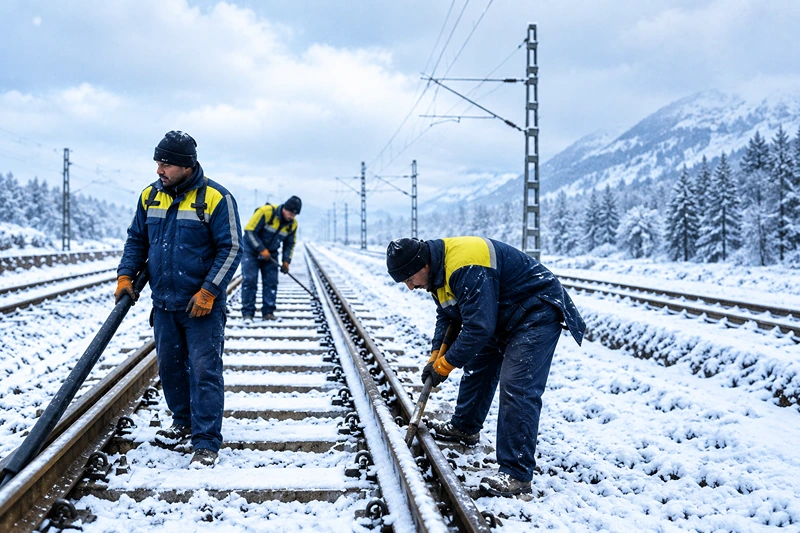
Rail infrastructure makes winter pours a massive headache. Pier caps, abutments, culverts, and station foundations are usually executed on brutal timelines. To make it worse, they’re often tucked away at remote chainages with a batching plant that’s a long, freezing drive away.
To keep your projects moving without structural failures, here is the non-negotiable site checklist to live by from November straight through to February.
Why November Is Where Things Go Wrong
November days usually feel mild enough, so crews just keep rolling like it’s still October. But then the night temperature plummets past 5°C, and nobody thought to tweak the plan. Here’s your baseline: the moment the ambient air drops below 5°C, you are officially in cold-weather concreting territory.
At low temperatures, hydration slows down to a crawl. If fresh concrete freezes before hitting roughly 3.5 MPa, its internal bonds are ruined for good. The worst part? The surface usually looks flawless. You won’t realize anything is wrong until the low cube test results drop weeks later long after you’ve cured, stripped formwork, and allowed loads on the structure. Always cross-verify your local specs against IS 7861 (Part 2) to see exactly what’s mandated for your alignment.
7 Things to Get Right Before and After Every Pour
Treat these seven steps as law. Skipping even one is how almost every winter concrete failure begins.
1. Watch the Forecast like a Hawk
· The Reality: A pour that looks completely fine at 4:00 PM can be covered in frost by 5:00 AM.
· Your Move:
o Check the minimum temperature forecast for the next 3 to 4 days out, not just tomorrow’s weather.
o Time your pours for the warmest window of the day usually between late morning and early afternoon.
o Have a hard backup plan. If an unexpected cold front creeps in, you either call off the pour or double your insulation.
2. Prep Your Subgrade, Rebar, and Formwork
· The Reality: Concrete dumped against frozen ground or icy steel loses its heat instantly, killing your bond strength.
· Your Move:
o Double-check that there is zero frost, snow, or ice sitting on the rebar or inside the shutters. Blast it out with warm air or low-pressure steam if you find any.
o Make sure the subgrade isn’t frozen solid. Never, under any circumstance, pour concrete over frozen earth.
o Strap your insulation material to the outside of the formwork before you call for the first transit mixer, not hours after.
3. Dial in Your Mix Design
· The Reality: A mix design that gave you great results in October will fail you miserably in January.
· Your Move:
o Keep the water-cement ratio tight. Use plasticisers for slump and workability never let your crew add raw water on-site to make it easier to pump.
o Throw in air-entraining admixtures if the structure is going to face heavy freeze-thaw cycles.
o Use non-chloride accelerators if you need a quick set. Stay away from calcium chloride if you’re dealing with reinforced or prestressed elements, unless you want rusted rebar down the line.
o Re-evaluate your cement. Blended cements like PPC gain strength notoriously slowly in the cold, so make sure your consultant signs off on the winter mix parameters early.
4. Monitor Batching and Transit Temps
· The Reality: Concrete has to show up warm enough to survive its first few critical hours. Most project specs ask for 5°C at placement, but smart site managers aim for 10°C to 15°C to give themselves a safety cushion.
· Your Move:
o Use heated mixing water at the plant, and warm up the aggregates if things are really freezing. Don’t ever heat the cement.
o Mix the hot water with the aggregates before introducing the cement to prevent a flash set.
o Make sure stockpiles aren’t full of frozen chunks, and throw insulated jackets over your transit mixers for the drive.
o Take a manual temperature reading on every single batch during discharge and log it in the site register.
5. Pour Fast and Protect Smarter
· The Reality: The first 24 to 48 hours make or break the concrete’s ultimate durability.
· Your Move:
o Keep the pour continuous. Long gaps between layers lead to ugly cold joints.
o Throw down your insulated blankets over plastic sheets the second the finishing crew steps away.
o If you’re running fuel heaters inside an enclosure, vent them outside. Unvented heaters fill the space with carbon dioxide, which causes carbonation on the wet surface, leaving you with a dusty, weak concrete finish.
6. Track Your Curing Temperatures
· The Reality: Winter air is surprisingly dry, and because strength gain is already lagging, keeping moisture in is everything.
· Your Move:
o Bury thermometers at the surface and right in the core of deep elements (like massive pier caps). Log the readings twice a day.
o Cast extra site cubes and cure them right next to the structure. This is the only way to see what kind of strength the actual structural member is achieving in the field.
o Don’t let the curing covers dry out; keep that moisture locked in for the whole protection window.
7. Don’t Rushed the Stripping
· The Reality: Popping shutters early is the most common shortcut taken when a project falls behind schedule.
· Your Move:
o Crush those field-cured cubes before anyone touches a single formwork bolt.
o Strip your thermal protection gradually. If you yank the blankets off all at once, the sudden temperature shock will crack the concrete surface.
o No structural loading, no girder launching, and no backfilling until the lab tests prove you’ve hit your design strength.
Railway-Specific Things Worth Planning Early
Traffic blocks and possession windows give you zero breathing room. When you’ve only got a three-hour track block, the temptation to just pour the concrete anyway no matter how cold it is.
To avoid making dangerous calls on the fly, sit down with the client and consultant before winter hits. Agree on a hard “go or no-go” temperature threshold. When that rule is written down in black and white, nobody is standing on a dark platform arguing about structural safety at 2:00 AM.
Remote alignments introduce serious supply chain lags. Things like heavy-duty thermal blankets, space heaters, fuel, and digital probes can take weeks to get to a remote site. Order them in October.
While you’re at it, brief your team. A transit mixer driver who actually understands why batch temperatures matter won’t just dump a cold load into your pump; they’ll alert the plant the second the temperature starts dipping during transit.
Quick Pre-Pour Checklist
Clip this to your board at the pouring site.
1. Weather: Did a check of the 3-to-4-day minimum temperature outlook?
2. Site Preparations: Rebar, formwork, and base have been completely cleared of ice and frost?
3. The Concrete: Is the winter mix design, including the necessary admixtures, completely approved?
4. Transport: Is there a temperature logging kit set aside for each incoming transit mixer?
5. Protection: Have the tarps, blankets and vented heater units been physically placed at the site before the trucks arrive?
6. Probing: Are thermometers available and ready with one specific person assigned to keep track of the information?
7. Testing: Extra cubes moulds in reserve in order to perform the curing test?
8. Decision Sign-off: Has a strict minimum temperature decision been agreed upon and finalized with the client’s engineer?

How GIRIRAJ Approaches Railway and Civil Projects
Giriraj Civil Developers Limited is a civil and railway construction firm building heavy infrastructure across India. Our teams take on everything from complex railway station buildings and staff quarters to road over bridges (ROBs), foot over bridges (FOBs), yard remodeling, track laying, deep earthworks, and major river bridges for the country’s primary rail authorities.
Managing a diverse spread of structures, permanent way work, and heavy earthmoving means our field crews have faced down pretty much every obstacle a tough rail site can throw at them. We run our projects on a foundation of innovation, tight quality control, uncompromising site safety, and a highly capable workforce. And those values matter most on the exact days when a critical pour has to go perfectly in the dead of winter.
Conclusion: Plan for the Cold Before It Shows Up
Cold-weather concreting comes down to preparation. Most failures trace back to someone skipping a step because the schedule was tight. Check the temperatures, protect the pour, and wait for the cubes before you strip. That covers most of it.