

 GIRIRAJ CIVIL DEVELOPERS LTD NSE
-
By @GirirajCivilDev
-
August 19, 2026
- 0 Comment
From Foundation to Track Bed: What MAHSR’s Construction Numbers Reveal About Modern Rail-Building Speed
The Mumbai-Ahmedabad High Speed Rail project, widely known as MAHSR, puts out a construction update every few months, kilometres of viaduct completed, a percentage of physical progress, a cumulative expenditure figure. Reported individually, these numbers tend to get skimmed and forgotten.
Looked at together, they describe something worth understanding: how a large-scale rail infrastructure project in India actually gains speed once its early bottlenecks are cleared. This piece walks through what MAHSR’s construction data shows, section by section, and what it reveals about the current pace of rail-building in the country.
1. The Land Had to Come First, and It Took Years
Before a single pier could go up, someone had to acquire 1,389.5 hectares of land across Gujarat, Maharashtra, and Dadra & Nagar Haveli. That process is finally done. Every bit of that land is in hand, all statutory clearances have been received, and all 1,651 utilities that were sitting in the way, cables, pipelines, transmission lines, have been shifted.
This part rarely makes headlines because there’s nothing to photograph. No viaduct, no crane, no visible progress. Even the earthworks, cutting, grading and embankment preparation along the alignment, don’t get much attention despite setting up everything that follows. But this stage decided how fast everything after it could move. Gujarat cleared its land relatively early. Maharashtra didn’t, and you can still see that gap in the numbers today.
2. From One Kilometre to Hundreds: How the Viaduct Pace Changed
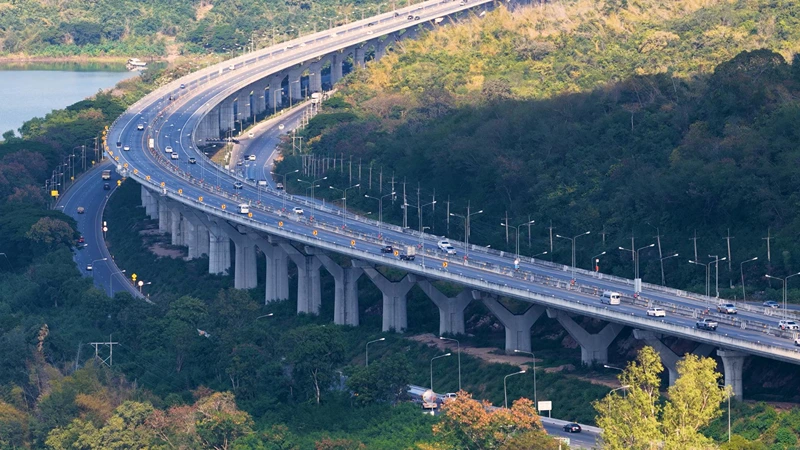
Here’s where the acceleration really shows up. The first kilometre of viaduct on this project was ready in June 2022, about seven months after the first girder was launched. Getting to 50 kilometres took until April 2023. Then 100 kilometres came just six months after that.
Once the teams and equipment settled into a rhythm, the pace kept compounding. By late 2025 the viaduct had crossed 325 kilometres. Early this year it passed 334 kilometres, and by mid-2026 it had climbed past 350 kilometres of the 508-kilometre corridor. More than 85 percent of the route runs elevated, so viaduct progress is basically a proxy for the whole project’s momentum.
3. Piers, Girders, and the Machinery Behind the Speed
None of this happens without the right method. NHSRCL leans heavily on Full Span Launching, where 40-metre box girders are lifted and placed as a single unit using specialised launching equipment. It’s roughly ten times faster than the span-by-span technique typically used on metro viaducts, and it’s a big reason the kilometre counts jumped the way they did.
Pier work has now crossed 440 kilometres. Girder casting and launching are moving in step behind it. Translating these specifications into cast piers and launched girders on the ground is the job of the civil works contractors and railroad engineers deployed across each package of the alignment. Even so, the split between states tells its own story. Gujarat has pushed foundation and pier work past 350 kilometres each, with girder casting and launching not far behind. Maharashtra, by comparison, sits at roughly 65 to 75 kilometres on the same measures. Same project, same contractors in many cases, very different terrain and land history.
4. Stations Are Catching Up Too
Twelve stations are planned along the route, from Mumbai to Sabarmati. Foundation work is complete at eight of them, Vapi, Bilimora, Surat, Bharuch, Anand, Vadodara, Ahmedabad, and Sabarmati, all in Gujarat. That’s not a coincidence given everything said above about land. Station buildings need a different kind of expertise from viaduct work, so this scope is usually handed to a dedicated railway station construction contractor rather than the teams running pier and girder packages.
The remaining sites, Thane, Virar, and Boisar in Maharashtra, along with the Mumbai terminus, are still catching up. Seventeen river bridges are already complete, mostly over Gujarat’s rivers in Valsad and Navsari districts, which gives a sense of how far ahead that stretch of the corridor is compared to the rest. As station work progresses, the connected infrastructure around it, road over bridges (ROB) and foot over bridges (FOB) linking platforms to nearby roads and colonies, tends to follow on its own timeline.
5. The Tunnel Under Thane Creek and the Mountains of Palghar
Maharashtra’s challenge isn’t really about paperwork anymore, it’s geography. The corridor includes India’s first undersea rail tunnel, running beneath Thane Creek between Ghansoli and Shilphata, and a tunnel-boring machine has been grinding through several kilometres of that stretch.
Further inland, the alignment cuts through hilly terrain in Palghar, where tunnelling crews recorded a second mountain breakthrough this year, achieved barely a month after the first one. That’s the kind of underground work you can’t speed up with a faster girder-launching method. It moves at the pace the rock allows, and it’s the main reason Maharashtra’s numbers lag behind Gujarat’s even now.
6. What the Numbers Actually Add Up To
Put it all together and, as of mid-2026, the Railways Ministry has put overall project completion at nearly 80 percent, with cumulative spending nearing ₹91,000 crore. That’s real, visible progress on the ground, viaducts, piers, bridges, station foundations, all moving at once across two states.
It hasn’t come cheap. The original sanctioned cost sat around ₹1.08 lakh crore. Current estimates are trending closer to ₹1.98 lakh crore, largely because of how long land acquisition dragged on in the early years. Time lost upfront tends to show up later as cost, and MAHSR is a fairly clean example of that trade-off playing out in real numbers.
7. Why the Slow Start Doesn't Tell the Whole Story
If you only looked at the project’s first few years, you’d assume it was stuck. Land disputes, court cases, a pace that felt more political than physical. The numbers from the last two years read completely differently. Once land stopped being the bottleneck, construction speed became a function of methodology, equipment, and how many fronts could run in parallel.
That’s really the lesson buried in all these kilometre counts. Rail-building speed in India isn’t limited by engineering capability. It’s limited by how quickly the groundwork, land, clearances, utility shifting, gets out of the way. Once that clears, as it has across most of Gujarat, the construction itself moves fast enough to surprise people who wrote the project off years ago.
Final Thoughts
MAHSR is still a project with unfinished sections, a revised budget, and a Maharashtra stretch that has real engineering left to solve. But the numbers coming out of Gujarat, hundreds of kilometres of viaduct, eight station foundations complete, seventeen river bridges done, show what happens when a rail project gets past its hardest phase and into pure execution.
The first operational stretch between Surat and Bilimora is being targeted for August 15, 2027, a date the Railways Ministry has tied deliberately to Independence Day. Whether that timeline holds will depend on how quickly Maharashtra’s tunnels and remaining stations close the gap. But if the last two years of viaduct data are anything to go by, the pace of Indian rail construction has genuinely changed, and MAHSR is where you can see it happening one kilometre at a time.
Projects of this scale run on a wide base of execution partners, civil works contractors, railroad engineers and earthworks teams working across stations, bridges and connected infrastructure.
Giriraj Civil Developers Limited is one of the established names in this space, counted among the top construction companies in Mumbai for railway and civil works. With experience across railway station construction, road over bridge (ROB) and foot over bridge (FOB) projects, and large-scale earthworks. If you’re looking for a dependable civil works contractor for your next railway or infrastructure project, Giriraj Civil Developers Limited brings the engineering depth and field experience to deliver it.