

 GIRIRAJ CIVIL DEVELOPERS LTD NSE

-
By @GirirajCivilDev
-
October 19, 2026
- 0 Comment
Elastomeric Bearings for Railway Bridges: Tender and Installation Checks
Bearings are the small part of a railway bridge that nobody looks at until something goes wrong. They sit between the girder and the pier or abutment, take the load of every passing train, and let the girder move a little with heat and traffic. When they work, you forget they exist. When they don’t, you get cracked pedestals, a jammed girder and a long meeting with the railway’s bridge cell.
Elastomeric bearings are a common choice for short and medium spans because they are simple and need very little maintenance. Simple still doesn’t mean you can be casual. Most of the trouble we see starts at two points, the tender stage and the installation stage. So that’s what this post covers, in the same way we’d explain it to a new site engineer over a cup of chai.
1. What an Elastomeric Bearing Does on a Railway Bridge
It is a block of rubber, usually with steel plates bonded inside it (that is the laminated type). It sits under the girder and does three jobs. It carries the vertical load of the girder and the train. It lets the girder rotate slightly when a train rolls over. And it allows a few millimetres of sideways movement as the temperature changes.
There is no sliding part and nothing to grease, which is why engineers like them. But every bearing has limits for load, rotation and movement. Go past them and the rubber starts to tear. So everything below comes down to one question. Will this bearing sit exactly the way the designer assumed?
2. Tender Checks: Read the Specification Before You Price It
Bearings look cheap in a bridge estimate, so people skim this part of the tender. That is usually where the surprises hide. Here is what we go through line by line:
- Which standard applies. Railway tenders normally point to the RDSO technical requirements for elastomeric bearings, which refer to IRC:83 (Part II). Use the exact version the tender names, because these documents get revised.
- Design values on the drawing. Vertical load, horizontal force, rotation and movement for each bearing location. If something is missing, raise it in the pre-bid query. After award is too late.
- Approved sources. Many railway tenders accept bearings only from approved manufacturers. Check that your supplier is on the list and that the approval is still valid.
- Inspection and testing. Who inspects, at whose cost, how many samples per lot, and what happens when a sample fails. Put that cost and time into your price.
- Delivery timing and documents. Bearings are made to order, so they must be on site before girder erection, with test certificates and guarantee terms in hand.
3. Checks at the Factory Before Dispatch
Please don’t wait for the truck to arrive before finding out something is wrong. A defect caught at the manufacturer is a phone call. A defect caught at site, with a traffic block already booked, is a bad week.
- Test certificates match the exact lot and batch being dispatched
- Length, width and thickness are within the tolerance on the drawing
- Steel plates are fully covered by rubber, with no exposed edges
- No cracks, blisters, air pockets or signs of poor bonding on the surface
- Each bearing is marked with size, capacity and batch number, and packed so nothing gets squashed in transit
4. Receiving and Storing Bearings on Site
Check what arrives against the challan and the test documents, not just the count. Then store the bearings in a covered, shaded spot, off the ground. Keep them away from oil, diesel, direct sun and any welding or gas cutting work. Tag each bearing with the pier or abutment it belongs to. Sounds basic, but mixed-up sizes at different locations happen more than anyone admits.
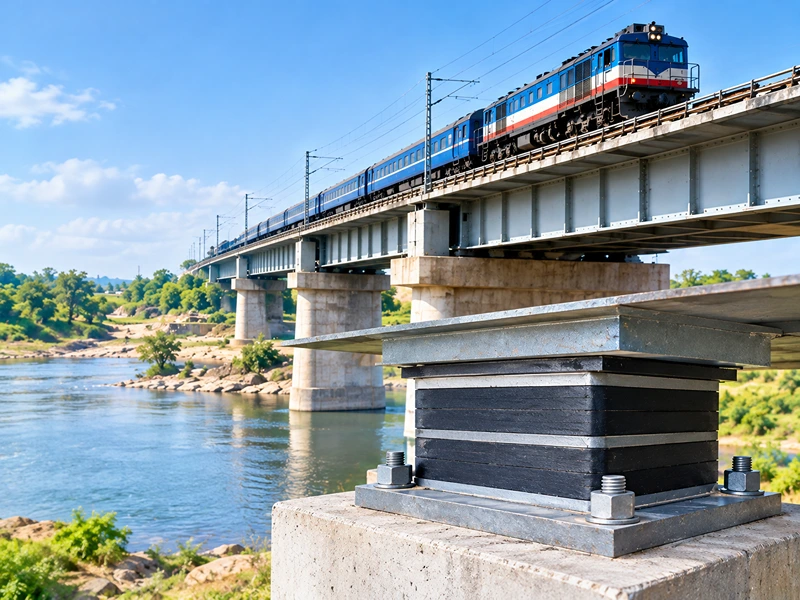
5. Installation Checks That Matter Most
On a railway bridge you often have a limited traffic block and one shot at lowering the girder. So the checks happen before that day, not during it.
Before the girder comes down:
- Bearing seat is level within the drawing tolerance. Use a level instrument. Eyeballing doesn’t count.
- Surface is clean, with no laitance, loose concrete, oil or mortar lumps
- Pedestal concrete has reached the strength the specification asks for
- Centre lines are marked on the seat and on the girder, and the seat is big enough that the bearing does not hang over the edge
While placing and lowering:
- Bearing sits flat with full contact, and the underside of the girder is level too
- Girder is lowered slowly and evenly. No dropping, no jerking, no one corner landing first.
- Temporary packing, wedges or transit plates are removed when the instructions say so
- No welding close to the bearing. If it can’t be avoided, protect the rubber and inspect it afterwards.
After the girder is seated:
- Look for bulging on one side, gaps at the edges, or a bearing that has shifted off its marks
- Record levels, positions and batch numbers as built, and take photos before the girder covers everything
- Get the railway engineer’s sign-off at each hold point
6. Common Mistakes We See on Site
The same few come up again and again. A seat that was not levelled, with thick mortar used later to hide it. A bearing nudged off centre while the girder was lowered. Temporary packing left in place. Wrong sizes at the wrong piers because the tags got mixed up. Soft earthworks behind an abutment that settle and tilt the seat over time. None of these are hard to avoid. They happen when the checklist gets treated as a formality.
7. Why These Checks Matter
A bearing costs a small fraction of the bridge. Replacing one under a live railway line costs a lot more, with jacking, a traffic block, fresh approvals and sometimes a speed restriction. A couple of hours on tender clauses and installation checks saves you all of that.
One more thing. Standards and RDSO documents get updated, so always cross-check the version named in your tender and your Railway engineer’s instructions before you finalise anything.
8. Building with Giriraj
Giriraj Civil Developers Limited is a Mumbai-based civil works contractor delivering railway and civil construction across India. Our work covers railway station buildings, railway bridges, road over bridge (ROB) and foot over bridge (FOB) projects, track works, railway yards and earthworks, built on quality, safety and a skilled workforce, with careful specification review, stage-wise inspection and documented installation.