

 GIRIRAJ CIVIL DEVELOPERS LTD NSE
-
By @GirirajCivilDev
-
June 15, 2026
- 0 Comment
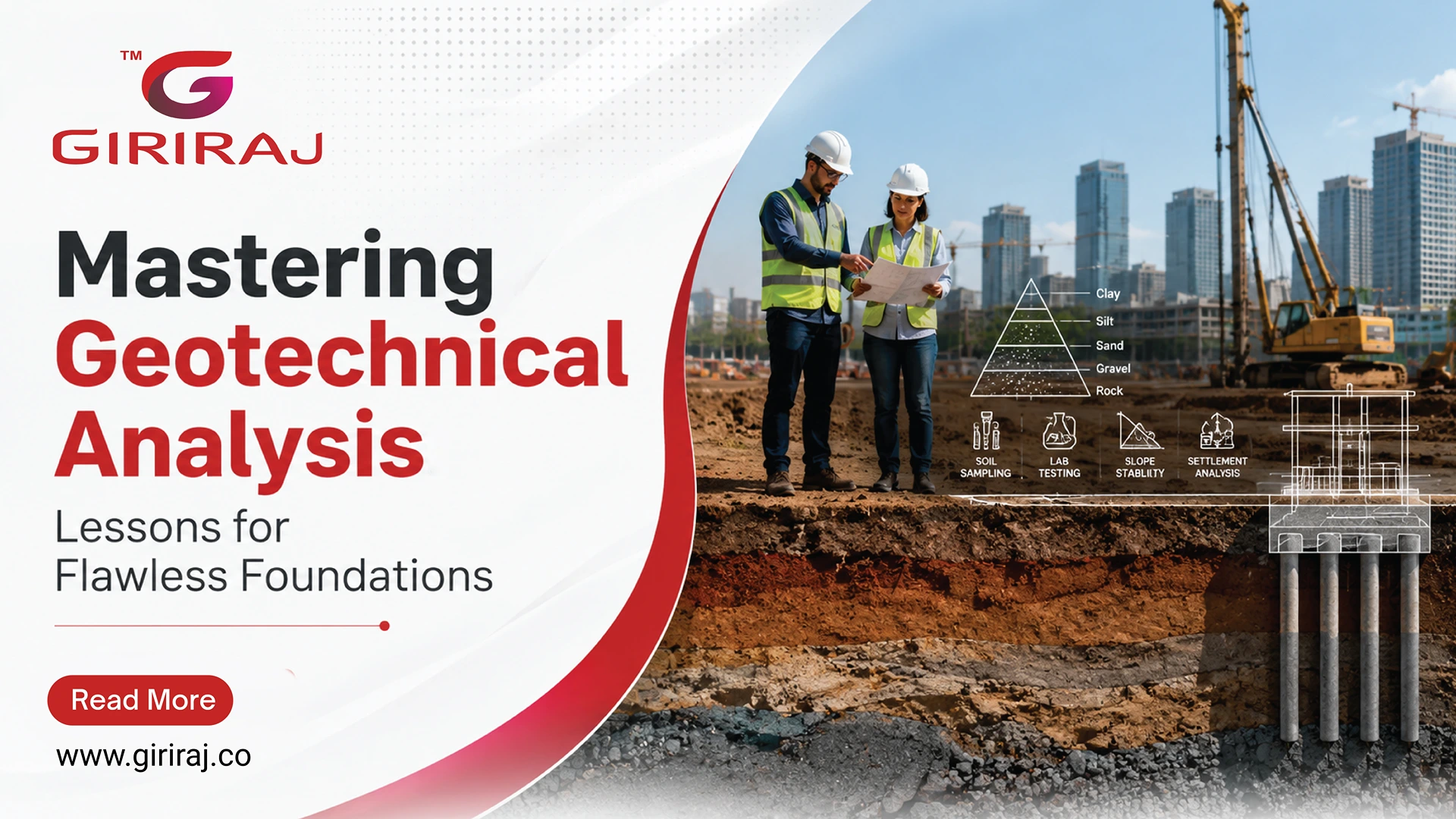
Mastering Geotechnical Analysis: Lessons for Flawless Foundations
Every structure you see standing tall a flyover, a railway station, a road over bridge (ROB) carrying traffic across a busy rail line has a story that starts underground. Not in the boardroom, not on the drawing board. Underground. That’s where geotechnical analysis lives, and it’s one of those things the industry talks about in theory but often rushes past in practice.
The cost of getting it wrong? Cracks. Settlements. Structural failures. Sometimes, complete collapse. The cost of getting it right? A foundation that holds for generations.
Let’s talk about what geotechnical analysis actually means for people building real things, and what separates projects that stand the test of time from ones that don’t.
1. What Is Geotechnical Analysis, Really?
Ask ten engineers this and you’ll get ten different answers. But at its core, geotechnical analysis is about understanding what the earth beneath a site is actually made of, how it behaves under load, and whether it can support what you’re planning to build on it.
It covers soil testing, rock analysis, groundwater assessment, slope stability checks, and seismic evaluations. The data gathered here feeds directly into foundation design whether you’re working on a high-rise, a railway station, or a foot over bridge (FOB) that thousands of commuters cross every day. Get this data wrong or skip it and every calculation that follows is built on assumptions.
And assumptions, as anyone who has worked in construction knows, are expensive.
2. Why Soil Investigations Get Skipped (And Why That's a Problem)
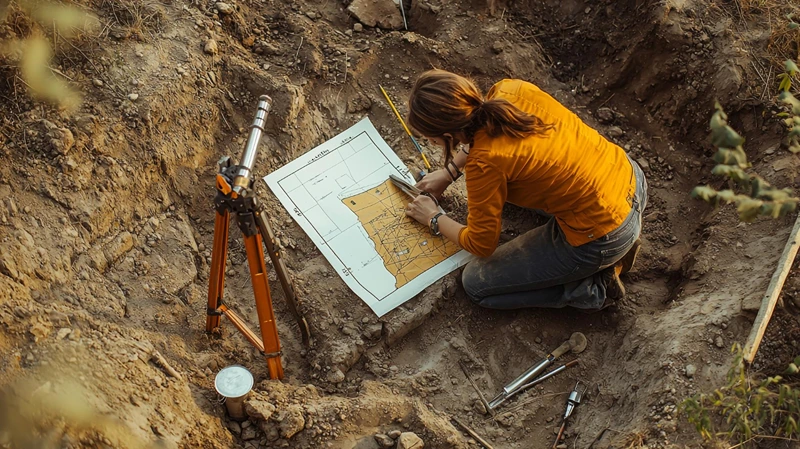
This happens more than anyone wants to admit. A project is under budget pressure. The timeline is tight. The site “looks fine” maybe a similar structure was built nearby a few years ago. So the soil investigation gets cut short, or done superficially, or borrowed from an older report.
Here’s the thing about soil it isn’t uniform. Even within a small site, you can have dramatically different soil conditions a few meters apart. One boring hole doesn’t tell the whole story. That old report from the adjacent plot? It’s a starting point, not a substitute.
The factors that lead to skipping proper investigation are almost always external cost, time, pressure from clients. But the consequences are structural, and they show up later, when fixing them is far more expensive than the investigation would have been.
3. The Most Common Foundation Failures and What Was Missed
Foundation failures don’t usually announce themselves dramatically. They creep in. A crack here. A slight tilt there. Doors that stop closing properly. By the time it’s visible, the damage is already significant.
The most common causes:
- Differential settlement: When different parts of a structure settle at different rates, because the soil wasn’t uniform and the foundation design didn’t account for that.
- Unexpected groundwater: High water tables that weren’t identified during investigation can weaken soil bearing capacity significantly.
- Expansive soils: Black cotton soil and similar expansive clays shrink and swell with moisture changes. Build on them without the right foundation system and you’re asking for trouble.
- Liquefaction in seismic zones: Saturated, loosely packed soils can behave like liquid during an earthquake. If the site isn’t assessed for this risk, the consequences can be catastrophic.
In most cases, these could have been identified and designed around if the geotechnical work had been thorough.
4. Lessons from the Field: What Actually Works
After years of executing railway and civil infrastructure projects across different geographies, a few things become very clear very quickly.
Start the investigation early. Not after the design is already half-baked. The geotechnical report should inform the design, not chase it. When investigation happens in parallel with or after design, you get situations where the design has to be changed entirely or worse, the team just works around the findings.
Use enough test points. The number of boreholes or trial pits should be proportional to the site complexity and the scale of the structure. For a railway station construction project or a large bridge spanning a busy corridor, you need enough data points to build a reliable picture of subsurface conditions across the entire footprint.
Don’t stop at standard tests. SPT (Standard Penetration Test) alone won’t always give you what you need. Depending on the site, you might need CPT, plate load tests, permeability tests, or consolidation tests. Know what the site demands and test accordingly.
Get a good geotechnical engineer, not just a testing lab. Data without interpretation is just numbers. A skilled railroad engineer or a seasoned civil works contractor knows that someone needs to understand what those numbers mean for the specific project the load conditions, the foundation type, the risk tolerance.
5. How Geotechnical Data Shapes Design Decisions
Good geotechnical data changes what you build and how you build it. Here’s how it actually flows through a project:
- Foundation type selection: Whether you go with shallow footings, raft foundations, pile foundations, or something else entirely depends on bearing capacity and settlement data from the investigation.
- Pile depth and diameter: The depth to which piles need to go is determined by where adequate bearing stratum is found. This isn’t a guess it comes from borehole data.
- Dewatering requirements: If groundwater is high, construction requires dewatering. Knowing this in advance lets you plan for it. Finding out during excavation leads to delays and cost overruns.
- Slope design for earthworks: For railway embankments, cuttings, and large grading operations, slope angles have to be calculated based on actual soil shear strength parameters. Too steep and it fails. Too conservative and you’re moving unnecessary material.
Every one of these decisions has cost implications. Good geotechnical data leads to efficient, right-sized designs. Poor or absent data leads to over-design in some places and under-design in others.
6. The Role of Construction Companies in Getting This Right
Here’s something that doesn’t get discussed enough: the construction company’s role in geotechnical work doesn’t end when the investigation report is handed over.
During excavation, site conditions often reveal things the investigation missed or only partially captured. Good construction teams document what they see. They flag inconsistencies between what was expected and what’s actually there. They escalate immediately when something looks different.
This is especially true for complex structures like a road over bridge (ROB) or a railway station construction contract, where the foundation has to carry heavy, dynamic loads and there’s very little margin for error. The feedback loop between field observation and engineering decision-making is where a lot of projects either protect themselves or expose themselves to risk.
7. Technology Is Changing How We Read the Ground
The traditional approach to geotechnical investigation is solid but slow. You drill, you sample, you test, you wait for lab results. It works. But the industry is getting access to tools that make this faster and more comprehensive.
Ground Penetrating Radar (GPR) can identify voids, buried structures, and anomalies without drilling. Seismic refraction surveys map subsurface layers over large areas quickly. LiDAR and drone surveys give precise topographic data for slope analysis. And digital data platforms are making it easier to visualize and share geotechnical findings across project teams.
None of these replace traditional investigation they supplement it. The combination of conventional testing and modern sensing gives a far more complete picture of what’s underground.
For large-scale infrastructure like railway corridors or freight terminals, where the footprint runs for kilometers and structures range from bridges and foot over bridges (FOBs) to full station buildings and earthworks embankments, these tools are shifting from nice-to-have to genuinely necessary.
What This Means for Infrastructure in India
India is in the middle of one of the largest infrastructure build-outs in its history. Railway station redevelopments, dedicated freight corridors, high-speed rail all of these rely on getting the ground conditions right. The scale of investment makes geotechnical thoroughness non-negotiable.
When foundations work, nobody notices. That’s the goal. A road over bridge that carries thousands of vehicles a day without a hint of settlement, a railway station that doesn’t crack unevenly, an embankment built on properly assessed earthworks that holds through monsoon after monsoon these are the outcomes of careful geotechnical work done early and done well.
The industry needs to move past treating geotechnical investigation as a checkbox. It’s an investment in getting the rest of the project right.
Final Thoughts
Flawless foundations don’t happen by accident. They happen because someone took the ground seriously before the first concrete was poured. Geotechnical analysis is that work and it deserves the same attention, budget, and respect that structural design gets.
For infrastructure companies in India operating at scale whether as a railway station construction contractor, a civil works contractor, or a railroad engineer overseeing complex multi-structure corridors the lesson is consistent: invest in understanding the ground. Everything else follows from there.
At Giriraj Civil Developers Limited, this is something we carry into every project the belief that what’s underground matters as much as what goes above it. Strong foundations aren’t built on hope. They’re built on data, expertise, and the discipline to do the geotechnical work properly, every single time.