

 GIRIRAJ CIVIL DEVELOPERS LTD NSE

-
By @GirirajCivilDev
-
November 4, 2026
- 0 Comment
EPC vs Item-Rate Contracts for Railway Civil Works: How the Risks Differ
Ask anybody that bid on railway work for a few years and they’ll tell you the same thing. The type of contract is as important as the rate you charge. On paper, two tenders can look almost identical and one can leave you with a lot more risk than the other.
In India, the majority of civil works on railroads are either item-rate contracts or EPC. They share the risk quite differently. This is how, in simple terms, so you know what you are getting into before you price anything.
1. What Is an Item-Rate Contract in Railway Civil Works?
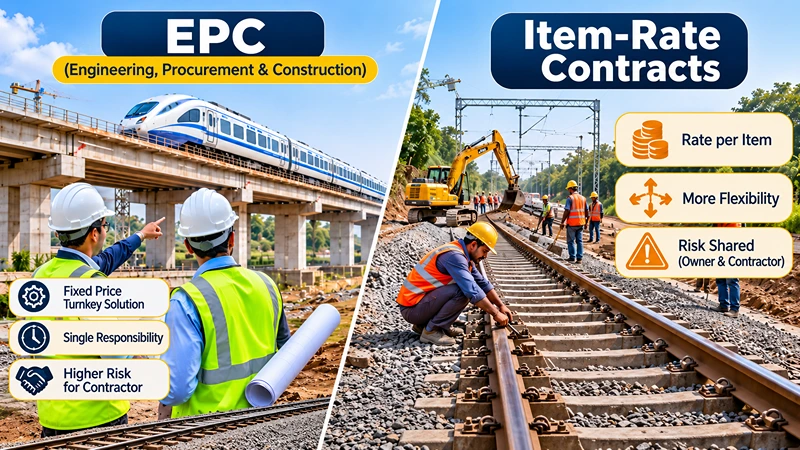
This is the classic setup. The railway gives you drawings and a Bill of Quantities. You quote a rate for every item, say earthwork per cubic metre or PCC per cubic metre, and you get paid for what actually gets measured on site.
- Design: the railway owns it
- Rates and execution: you own them
- Payment: follows measurement
It’s easy to price and easy to understand, which is why it has been the default for so long.
2. What Is an EPC Contract in Railway Projects?
EPC stands for Engineering, Procurement and Construction. You’ll normally quote a fixed price for the whole job, and the design, materials and building are all your responsibility. More often, this is the way bigger projects such as new lines, major bridges and yard works are being tendered.
Payment is milestone based rather than quantity measured. Reach the milestone, get the cash.
3. Design Risk: Who Is Responsible in EPC vs Item-Rate Contracts?
In an item-rate contract, a wrong or late drawing is mostly the railway’s problem, and you can raise a claim for it. Under EPC you’re responsible for the design, so errors, rework and approval delays land on you.
Drawings still need sign-off from the railway, and that can take much longer than anyone plans for. Before bidding, check:
- Who approves the design, and how many days they get
- What happens if the railway asks for changes after approval
- Whether the design standards are clearly stated in the tender
4. Quantity and Price Risk in Railway Construction Contracts
With item-rate, the quantity risk is mostly on the employer. If quantities go up you’re paid for more, and if they drop you earn less. Variation clauses usually provide some relief once the change exceeds a certain threshold. But your rates are fixed so a sudden jump in steel or cement hurts unless you have a price variation clause.
With EPC the lump sum is the lump sum. If you under-estimate the scale, you pay the price. Most EPC arguments come down to one question: was this item included in the price or not?
- Item-rate: the employer carries quantity risk
- EPC: the contractor carries quantity risk
- Both: read the price variation clause before you bid
5. Ground Conditions and Geotechnical Risk in Railway Projects
Every railway site has a story of a foundation that encountered something no one expected. In item rate contract, extra depth or change of strata normally means extra quantity and it is measured and paid.
Under EPC, you priced it, so you own it, unless the contract says otherwise. This makes the soil investigation data very important. If the tender provides thin geotechnical information, either add a buffer to your price or request more data in the pre-bid meeting.
6. Delays, Traffic Blocks and Approvals in Railway Civil Works
Railroad sites have constraints most civil sites don’t see. Traffic blocks, power blocks, working next to live tracks and safety clearances all take away from your schedule.
In item-rate contracts these delays are usually treated as employer delays and you can ask for an extension of time. In EPC the contract defines who is responsible for what. The wording is where claims are won or lost. Look closely at:
- Land handover dates
- Block availability commitments
- Who is responsible for utility shifting
- Statutory clearances and who gets them
7. Payment Terms and Dispute Risk: EPC vs Item-Rate
Item rate contracts are paid on running bills on the basis of measurement. Cash flow is steady as long as measurements are on time. EPC pays on milestones, so one stage delayed can delay your money for months.
The disputes look different too. Item-rate arguments are mainly concerned with the measurement and rate of extra items. In EPC cases, the arguments relate to the extent and the cause of the delay.
8. EPC or Item-Rate: Which Contract Suits Your Railway Project?
None of them is superior. Item-rate is best utilized when the scope is clear and the design is finished such as station buildings, foot over bridges, and standard earthwork. EPC is suitable for big integrated packages when one party taking over both design and construction work considerably saves coordination time.
The right question is who is best placed to manage each risk on that particular project.
Contract Risk Checklist for Railway Contractors Before Bidding
Read the risk allocation, not just the Bill of Quantities. Before you bid, go through these points:
- Who owns design and approvals
- How scope changes are handled
- What the variation and price variation clauses say
- What the contract says about land, blocks and utilities
- How good the soil data really is
If something is unclear, raise it in the pre-bid meeting. It costs a lot less to ask before you sign than to argue after.
Final Thoughts on EPC vs Item-Rate Contracts for Railway Works
Both item-rate and EPC can be good for railroad civil projects. The problem arises when a contractor quotes an EPC job as an item-rate one or vise versa. Know who carries which risk, and price accordingly.
At Giriraj Civil Developers Limited, we work across railway stations, bridges, ROBs, FOBs, track works, yards and earthworks, and we pay close attention to contract terms before every bid. If you’re looking for a reliable partner for railway and civil construction, GIRIRAJ brings the experience and execution to get it done.