

 GIRIRAJ CIVIL DEVELOPERS LTD NSE
-
By @GirirajCivilDev
-
June 17, 2026
- 0 Comment
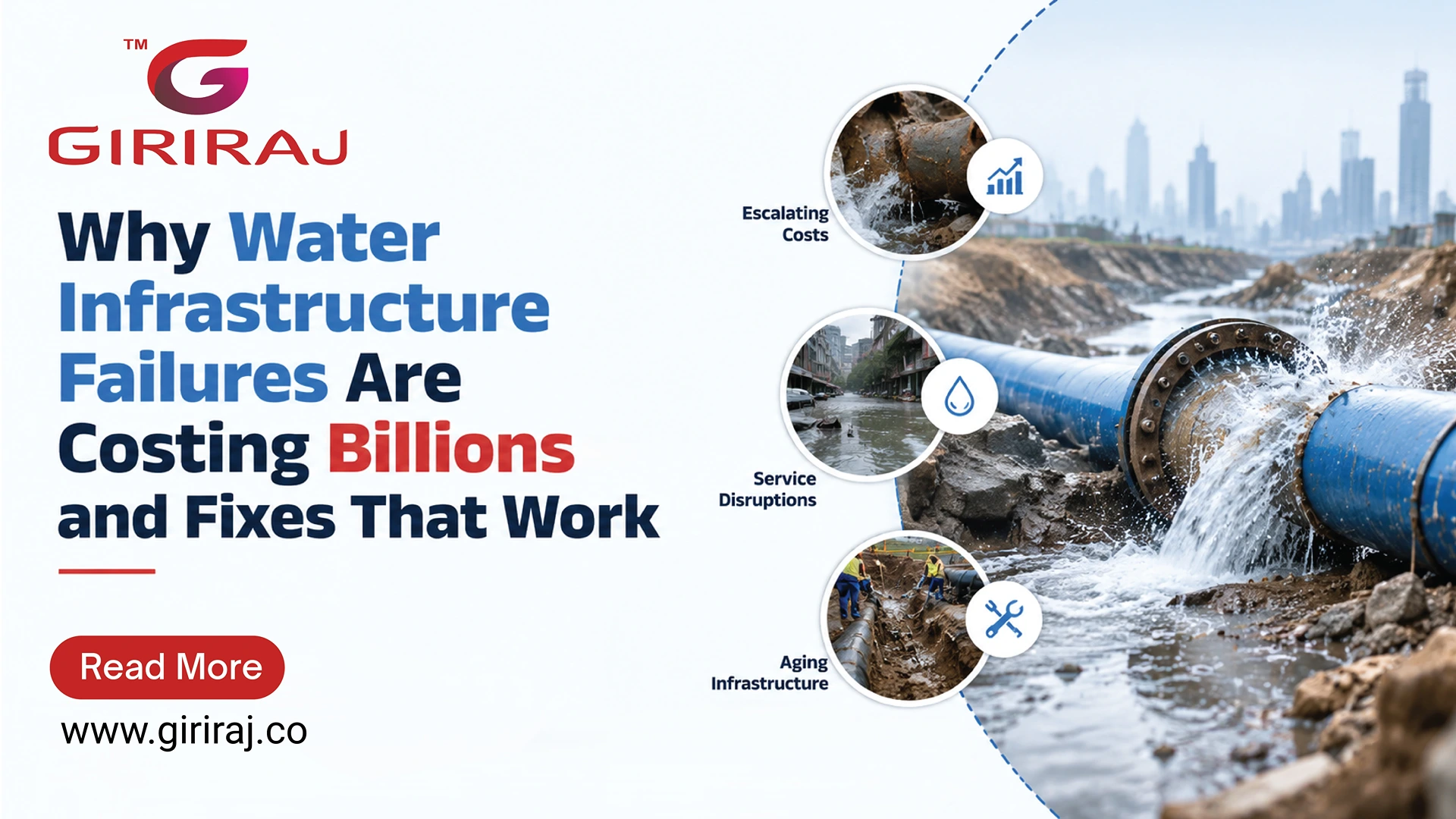
Why Water Infrastructure Failures Are Costing Billions and Fixes That Work
Water infrastructure is failing. Not slowly, not quietly it’s bleeding money, making people sick, and nobody’s really treating it like the crisis it is.
Pipes that were laid in the 1960s are still running today. Leakage rates in Indian cities sit between 30% and 50%. That’s treated water, expensive water just vanishing underground before it reaches anyone. The World Bank puts the annual cost of poor water infrastructure at $260 billion in lost productivity. That’s just productivity. It doesn’t count hospitals, agricultural losses, or the hours women and children spend walking to collect water every single day.
The problem isn’t complicated to understand. The fixes aren’t mysterious. What’s been missing is urgency and execution. Let’s get into both.
1. The Scale of the Problem
Here’s a stat that stops you in your tracks: about 2 billion people worldwide still don’t have access to safe drinking water at home. That’s not a third-world-only problem either. Cities like Flint, Michigan made global headlines for lead-contaminated water. Cape Town nearly ran out of water entirely in 2018. Chennai ran dry that same year.
In India, the situation is particularly urgent. A large chunk of the water distribution network is decades old. Leakage rates in many Indian cities sit between 30% and 50% meaning nearly half the treated water never reaches anyone. It just disappears into cracked pipes underground.
That’s treated water. Expensive water. Water that required electricity, chemicals, and labour to clean, now just… gone.
2. Why Water Infrastructure Fails in the First Place
It’s rarely one big dramatic failure. It’s a slow accumulation of small neglects.
- Ageing assets: A lot of water infrastructure in Indian cities was built in the 1950s to 1980s. These pipes, reservoirs, and pumping stations were designed with a 30-40 year lifespan. Many are now running on 60+ years. No amount of patching changes that math.
- Underfunding: Water departments are chronically underfunded. Maintenance budgets get cut before capital budgets do, which means small problems quietly become large ones.
- Population pressure: Cities grew faster than anyone planned for. Infrastructure built for a city of 2 million is now serving 8 million. The stress shows.
- Weak monitoring: Without sensors and real-time data, leaks go undetected for months. By the time someone notices a wet patch on a road, the damage is already significant.
- Poor construction quality: Some of it comes down to shortcuts taken during original construction wrong materials, inadequate depth, skipped pressure testing.
3. The Real Cost — Beyond Just Money
The financial losses get the headlines. But the human cost is where it really hits.
When water supply is unreliable, households especially lower-income ones resort to buying water from tankers at 5 to 10 times the cost. Women and children in rural areas spend hours every day walking to collect water. That time doesn’t show up in GDP calculations, but it’s real lost potential.
Contaminated water means hospitals fill up with preventable diseases. Diarrhoea alone kills around 525,000 children under five globally every year, most of it tied to unsafe water and sanitation. Industries that depend on clean water, food processing, textiles, pharmaceuticals face productivity losses and compliance problems.
And then there’s the long-term economic drag. Businesses don’t set up in cities where water supply is unreliable. Investors look elsewhere. The city slowly falls behind.
4. What Fixing It Actually Looks Like
The fixes aren’t magic. They’re mostly well-understood civil engineering combined with better planning and more consistent execution.
1. Pipeline Rehabilitation and Replacement
Old cast iron or asbestos cement pipes need to come out. Modern HDPE (High-Density Polyethylene) and ductile iron pipes are more durable, flexible, and far less prone to leaks. Trenchless rehabilitation techniques like pipe relining and pipe bursting mean you can replace pipes without tearing up entire roads faster, cheaper, less disruption. Where open-cut methods are unavoidable, proper earthworks — shoring, compaction, and backfilling are what prevent the road above from sinking six months later.
2. Decentralised Water Treatment
Rather than relying on one massive central treatment plant serving an entire city, decentralised plants serving specific zones are becoming more practical. They’re easier to maintain, quicker to build, and reduce the pressure on a single point of failure.
3. Rainwater Harvesting and Groundwater Recharge
Cities like Rajkot and Bengaluru have run aggressive rainwater harvesting programmes with real results. Rooftop collection systems, percolation pits, and recharge wells help replenish groundwater that’s been over-extracted for decades. It’s not a silver bullet, but it takes real pressure off conventional supply systems.
4. Wastewater Recycling
Treated wastewater can be reused for industrial processes, construction, agriculture, and even toilet flushing. Singapore does this exceptionally well with its NEWater programme, meeting up to 40% of its water demand through recycling. India is gradually moving in this direction, with several cities setting up tertiary treatment facilities.
5. Technology's Role in Smarter Water Systems
This is where things are genuinely getting exciting. Water management is becoming a data problem as much as an engineering one.
- IoT-based leak detection: Sensors installed at key points in the network measure flow rates and pressure in real time. Any sudden drop in pressure or unexpected flow variation triggers an alert. Leaks get found in hours, not months.
- SCADA systems: Supervisory Control and Data Acquisition systems let operators monitor and control the entire network from a central dashboard. Valve positions, pump status, tank levels all visible in real time.
- AI-based demand forecasting: Predictive models can anticipate demand spikes before a festival, during a heatwave, as a new neighbourhood fills up and adjust supply accordingly.
- Digital twin technology: A virtual model of the entire water network that can be used to simulate scenarios before making physical changes. Want to know what happens to pressure if you add a new supply line? Run it on the digital twin first.
Cities that have adopted these technologies are reporting 20-40% reductions in non-revenue water, that’s the water that gets treated but doesn’t generate any income because it leaks or gets stolen. That’s a massive saving.
6. The Role of Infrastructure Companies
None of this happens without companies on the ground actually building things.
The design can be perfect. The funding can be in place. But if the civil and structural execution is poor wrong pipe grades, badly compacted trenches, inadequate joint sealing you’re back to square one in five years.
Good civil works contractors bring:
- Quality material sourcing and testing before installation
- Experienced site teams who understand hydraulic requirements, not just construction basics
- Rigorous pressure testing protocols before any new line is commissioned
- Timely execution that keeps projects on schedule and within budget
- Post-completion monitoring and snag resolution
The quality of the contractor genuinely determines whether a water project delivers on its promise for 30 years or starts causing problems in three.
7. What This Means for India
India’s Jal Jeevan Mission set an ambitious target: piped water to every rural household by 2024. Progress has been significant, over 140 million households connected since the mission launched. But connection and reliable supply are two different things. Getting water to the tap is step one. Keeping it clean, continuous, and affordable is the harder, longer job.
AMRUT 2.0 (Atal Mission for Rejuvenation and Urban Transformation) is pushing urban water reform. The focus is on 100% household water supply coverage in cities and towns, with a clear emphasis on O&M (Operations and Maintenance), the part that usually gets ignored.
For infrastructure companies, this represents a long runway of work. Water pipeline projects, sewage treatment plants, pumping stations, overhead tanks, distribution networks, the pipeline of projects (pun intended) is substantial.
And unlike some infrastructure sectors, water isn’t optional. You can delay a metro. You can postpone an expressway. You cannot ask people to wait for water.
Final Thoughts
Water infrastructure failures are expensive, yes. But they’re also fixable. The technology exists. The engineering knowledge exists. The policy frameworks are improving. What has historically been missing is consistent investment, disciplined execution, and long-term maintenance culture.
That’s changing. Slowly, but visibly. Cities are upgrading networks. Governments are putting real money in. And companies that know how to execute civil infrastructure with precision and quality are becoming genuinely critical partners in that journey.
Water is not a glamorous infrastructure category. You don’t get ribbon-cutting ceremonies for underground pipes. But get it right, and you improve the lives of millions of people in ways that are immediate and lasting.
That’s worth taking seriously.
At Giriraj Civil Developers Limited, we understand that water infrastructure is not just another construction project, it’s a lifeline. With deep expertise in civil construction and a proven track record across India’s infrastructure sector, we bring the engineering precision and on-ground experience that water projects demand.
From pipeline laying and earthworks to large-scale civil structures, our teams are equipped to execute complex projects on time, to spec, and to the quality standards that long-lasting infrastructure requires. If you’re looking for a trusted civil construction partner, Giriraj Civil Developers Limited brings experience, dedication, and engineering excellence to every project.